
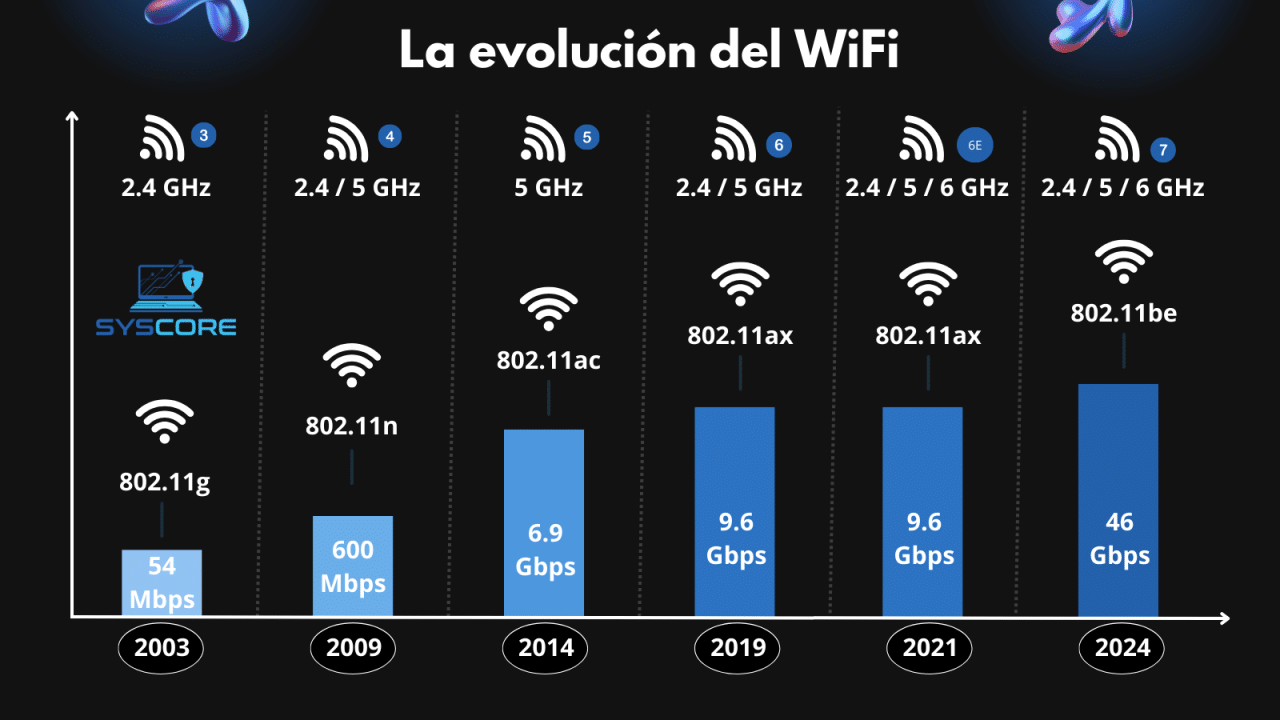
Each year we are more hooked on WiFi connections. The main reason is that we have them more and more in our daily lives and we depend on them to carry out any task. In addition, the portable devices we use, such as smartphones, tablets, etc., have increased. Do you want to know how WiFi has evolved to the present day?
What is WiFi?
WiFi is a trademark of Wi-Fi Alliance (formerly known as WECA), the organization that adopts and certifies equipment that complies with the 802.11 WLAN standards. It is the technology used in a wireless network or connection for data communication between equipment located within the same area.
Certified Wi-Fi standards are very popular worldwide, threatening the availability of radio spectrum, especially when connections must be established at more than 100 meters (increasing the risk of interference).
Various certified Wi-Fi standards.
You can also learn about the Nagios WiFi Configuration, Administration, and Monitoring.
The Evolution of WiFi Today
The 802.11n generation is still expanding, but a new, much faster standard suited to new wireless technologies is already being developed. In these, device movement is more frequent; this is IEEE 802.11ac. A set of standards created by the WiFi consortium with the new 802.11ac standard.
The 802.11ac standard will allow speeds of up to 1Gbps on the 5GHz band. The idea is to update 802.11a so that it can use 80 or 160 MHz channels and increase data transmission capacity (bandwidth). This will allow for a greater signal range, even with obstacles in the way, one of the weak points of wireless connections.
Currently, there are already products certified with this standard, but large-scale commercialization is expected to take place in later years. It will be necessary to update current equipment, such as network cards, routers, laptops, mobile devices, internet connections, etc., to adapt them to the new standard. Therefore, in principle, 802.11ac could be a more suitable option for the business sector or the deployment of access points in public administration.

In the graphs shown above, we see a comparison between the 802.11n and 802.11ac standards.
The graph below shows the relationship between data rate and distance for the 802.11n and 802.11ac standards. As we can see, the 802.11ac standard performs better than the 802.11n standard.

The image above shows a comparison table of the features of both technologies.
IEEE 802.11ad.
The immediate future lies with the 802.11ac standard, but work is already underway on a new technology: the 802.11ad standard. It will use the 60 GHz band in addition to the current bands (2.4 GHz and 5 GHz), with data transfer speeds of up to 7 Gbps. The evolution of Wi-Fi continues to move forward.
Discover how Boost Your WiFi Speed with 5 More Effective Tips.