
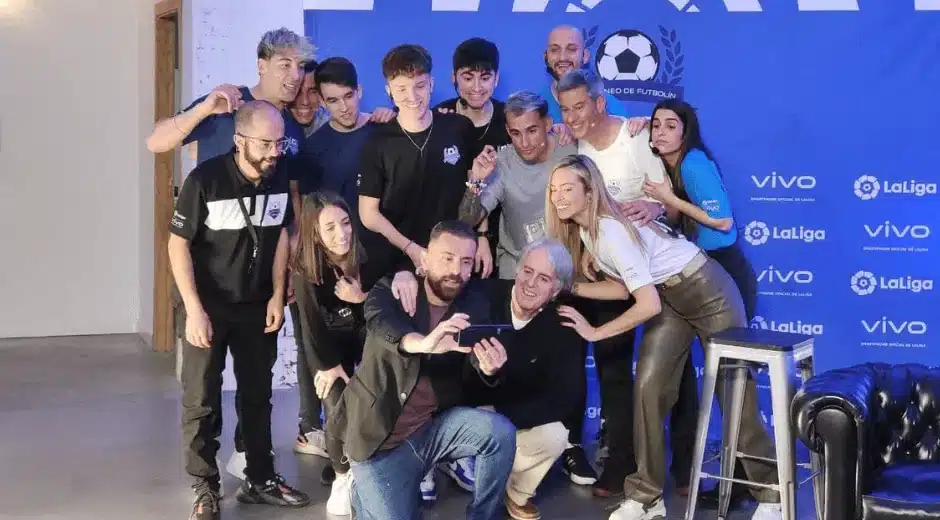
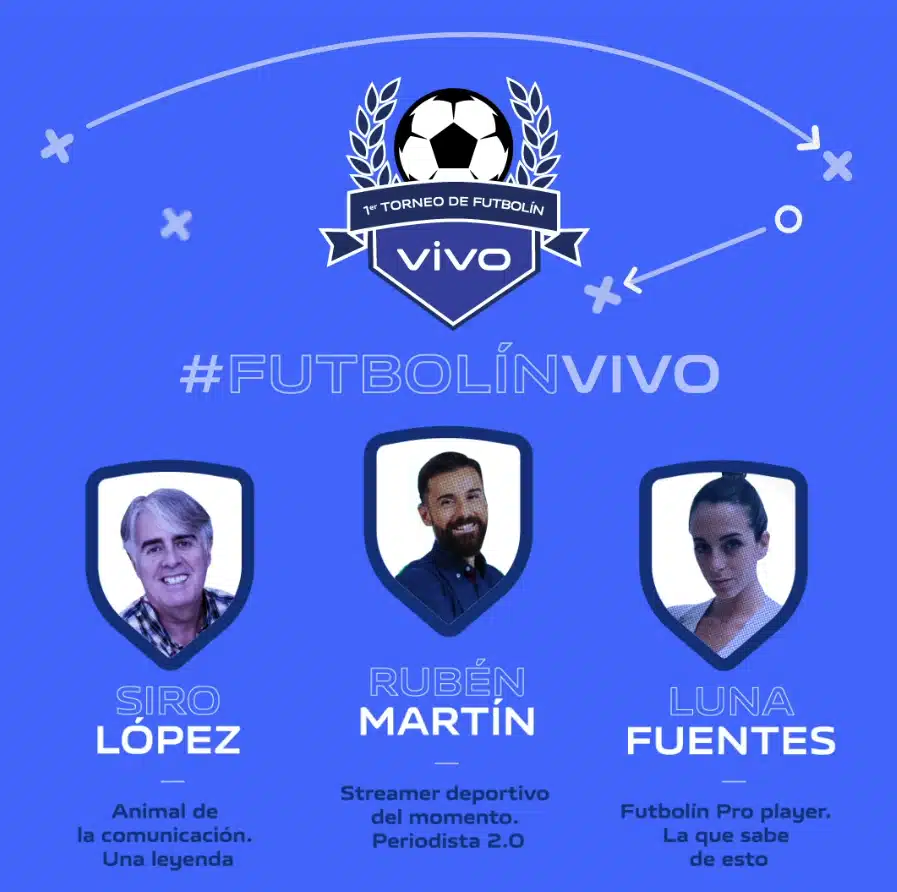
Siro López playing foosball live on Twitch. Alongside him, other top sports journalists and sports influencers.
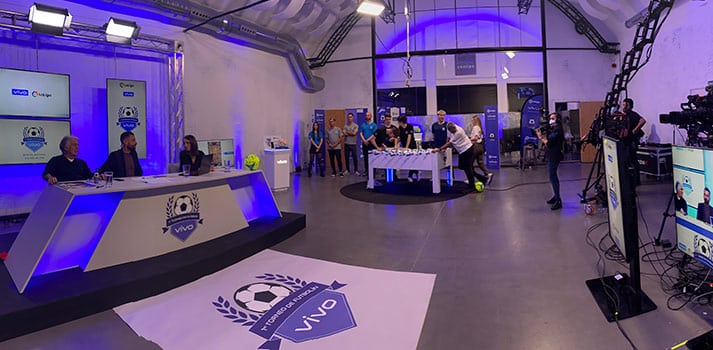
So far, it sounds like viral content. However, what was behind the screen was a top-tier technical deployment: six fixed cameras, a six-meter crane, broadcast-grade Canon 4K lenses (CJ24ex7.5B IASE S 2/3” 7.5-180 mm 4K), VIVO mobile phones used as cameras via WiFi with an NDI signal, Shure ULX-D wireless microphones, a production control with an ATEM mixer, a Swit radio link for wireless cameras, and a complete redundant encoding system for broadcasting online.
enbex was the audiovisual production company in charge of designing, setting up, and operating all the technical aspects of this event. From image and sound capture to final encoding and sending the signal to Twitch. This article explains, step by step, how a professional broadcast ecosystem was set up for a format that mixed entertainment, sports, and technology in a way that had never been done before.
The format: first foosball tournament online on Twitch
The idea was as original as it was technically demanding. Figures like Siro López, along with other sports journalists and influencers, competed in foosball matches broadcast live on Twitch. When someone with that media presence participates in an event, the production cannot look amateur. A webcam and a desk mic won't cut it. The caliber of the talent demands the caliber of the technical production.
This is why a multi-camera setup with a crane, close-ups, graphics, and professional audio was put in place. The goal was for the Twitch viewer to experience every goal, every play, and every reaction with the same quality they would expect from a television program. To achieve this, an audiovisual production company that also mastered the social media and streaming side was needed. That's where enbex came in.
Six cameras, a crane, and Canon 4K broadcast optics
The image capture was designed to cover every angle of the tournament. A total of six fixed camera positions covered the action from different points: wide shots of the room, medium shots of the players, and overhead shots of the tables.
Additionally, a six-meter crane provided cinematic camera movements. Wide panning shots, descents onto the table, and player tracking gave the stream a visual dynamic far above the usual on Twitch. The viewer didn't just watch the tournament; they felt like they were inside it.
The optics used were Canon broadcast-grade, with 4K resolution. This type of lens offers a sharpness and depth of field not achieved with consumer equipment. Close-ups of the foosball figures, the players' hands, and the details of the table had a visual quality that only professional equipment can provide.
ViVO Mobile Devices as Cameras: Innovation in WiFi and NDI
This is where the project gets really interesting from a technical standpoint. VIVO, as a sponsor of the event, provided cutting-edge mobile phones that were used as additional cameras. These phones captured close-ups of the action at the foosball tables from angles that a conventional camera couldn't cover.
Each mobile phone's video signal was transmitted via WiFi to the event network. To do this, the wireless network was configured specifically: clean channels, reserved bandwidth, and minimal latency. It wasn't a WiFi for browsing the internet. It was a WiFi optimized for carrying real-time video.
Once on the network, the signal was converted to NDI (Network Device Interface). This protocol allows professional-quality video and audio to be transmitted over a standard IP network. In this way, the production control room received the signals from the smartphones as if they were additional cameras in the system. The director could cut to a close-up captured by a VIVO mobile device just as smoothly as cutting to the crane or any fixed camera.
Making this work without visible lag, loss of quality, or interruptions requires in-depth knowledge of both audiovisual production and network engineering. It is precisely this combination of skills that defines enbex as an audiovisual production company with a technical DNA.
Execution Control: ATEM and a Complete Broadcast Ecosystem
All video feeds—from the six fixed cameras, the crane, the VIVO mobile cameras via NDI, and the wireless camera—were sent to the production control room. At the heart of that control room was a Blackmagic ATEM switcher, the industry standard for live production.
From the ATEM, the director managed the camera cuts, transitions, graphic overlays, and the final program mix. The output signal from the switcher was what viewers saw on Twitch. Therefore, everything had to be synchronized down to the millisecond: video, audio, graphics, and transitions.
The broadcast ecosystem was completed with real-time monitoring of all sources. The director saw each of the inputs on their multiviewer before sending them to air. This way, they could anticipate the next cut and react to the tournament's action with the agility that a live broadcast demands.
Swit Wireless Camera with Radio Link
To gain freedom of movement, one of the cameras operated wirelessly thanks to a Swit radio link. This system transmits the HD video signal from the camera to the control room via radio frequency, eliminating the need for an SDI cable.
At an event where camera operators move between foosball tables, through the audience, and backstage, a cabled camera significantly limits creativity. With the Swit link, the operator could follow a player, capture a spontaneous reaction, or get a B-roll shot of the atmosphere without worrying about cable length.
However, wireless radio links require careful spectrum management. In an environment with active WiFi, mobile devices transmitting over NDI, and Shure wireless microphones, available frequencies are reduced. Coordinating all these wireless systems was a critical part of the technical design.
Professional Audio: Shure ULX-D with 24-bit digital quality
The sound of the event was captured with a Shure ULX-D wireless microphone system. This range offers 24-bit, 48 kHz digital audio, with a dynamic range of 120 dB. In practice, this means sound quality equivalent to that of a wired microphone, but without the physical limitations of cables.
The hosts, commentators, and tournament participants wore Shure bodypacks with lavalier or headset microphones. Each audio signal arrived at the ULX-D receiver and from there to the audio mixer, where levels were adjusted, EQ was applied, and the final mix was sent to the ATEM for broadcast.
The Shure ULX-D system also incorporates AES 256-bit encryption, which protects the signal from unwanted eavesdropping. It also includes automatic interference detection, which is very useful in an environment with so many wireless systems active at the same time.
Redundant internet and encoding for Twitch
The final program feed—already mixed, with audio and graphics—exited the ATEM towards the encoding system. A professional encoder compressed the feed in real time and sent it to the Twitch servers via the internet.
As with all enbex projects, the internet connection was redundant. Two links from different providers with load balancing and automatic failover. If one went down, the other would take over without interrupting the stream. Furthermore, the encoder itself had its backup: a second encoding unit ready to go online if the primary one failed.
On a Twitch livestream, a stream drop means losing viewers. Recovering them after a cut is very difficult. For that reason, redundancy was not optional. It was part of the design from the very beginning.
When audiovisual production and social media merge
This project is a clear example of why enbex defines itself as an audiovisual production company with technical capabilities in networks and connectivity. In a tournament like this, separating the two disciplines would have been a mistake.
VIVO mobile phones transmitted video over Wi-Fi. The Wi-Fi had to be designed to carry those signals without delay. The signals were converted to NDI, a network protocol. The NDI traveled over switches configured to prioritize that traffic. And at the end of the chain, the encoded signal exited through a redundant internet connection.
If the audiovisual production company doesn't understand networking, NDI won't work. If the networking company doesn't understand production, the Wi-Fi won't be configured for video. At enbex, the two go hand in hand. That's the difference.
Technical specifications
Event: First online foosball tournament on Twitch. Participants: Siro López, sports journalists, and sports influencers.
Image: 6 fixed cameras + 6-meter crane. Canon 4K broadcast lenses. VIVO mobile cameras connected via WiFi/NDI. Wireless camera with Swit link.
Sound Shure ULX-D wireless microphone system. 24-bit / 48 kHz digital audio. AES-256 encryption.
Realization: Blackmagic ATEM switcher with all sources in NDI and SDI. Live production with graphics.
Streaming Redundant encoding to Twitch. Dual-link internet, load balancing, and automatic failover.
Red Wi-Fi optimized for NDI video transport. Traffic segmentation to separate production, sponsor, and services.
Result: Full rebroadcast on Twitch without cuts, with broadcast quality and a visual experience far above the platform's standard.
Are you looking for an audiovisual production company that also excels in social media and streaming? Contact enbex. We make technology tell stories.