
Twenty Starlink antennas pointing at the sky from a motocross track. All working at once. All connected in a single link capable of broadcasting a Grand Prix on television. That's what Enbex set up for the MXGP of Spain. It wasn't a typical deployment. It was a solution designed from scratch for a problem that no one had solved before on this scale: offering internet for an event global reach and impact sports.
This article explains how that infrastructure was designed and operated. From the decision to use satellite internet as the only possible way, to how twenty connections were unified into a single data flow. A flow that fed a mobile television unit and served the press, media, accreditations, and organization at the same time.
A circuit without fiber, without coverage, and without alternatives
Motocross tracks are built on natural terrain, far from urban centers. That makes them perfect for competition. But it turns them into a nightmare for telecommunications.
When evaluating the MXGP of Spain venue, the result was clear. There was no fiber optic. Nor was there 4G or 5G coverage with sufficient capacity to sustain a live broadcast. Hiring a dedicated link from an operator was not viable within the event's timeframe.
For a Motocross World Championship Grand Prix, that's a serious problem. We're talking about an event with a global television audience. Dozens of accredited media covering each race. Timing systems working in real-time. And an organization that needs to be connected all weekend long.
Without a network, the event doesn't work. It's that simple. Enbex's solution was as big as the problem: deploy twenty Starlink terminals and connect them into a single high-capacity link.
Why Starlink and why twenty antennas
Starlink is SpaceX's low-Earth orbit satellite network. Its satellites fly at altitudes between 340 and 550 km. This allows for latencies of 20 to 40 milliseconds, much lower than traditional satellites, which orbit at 36,000 km and generate delays of over 600 milliseconds.
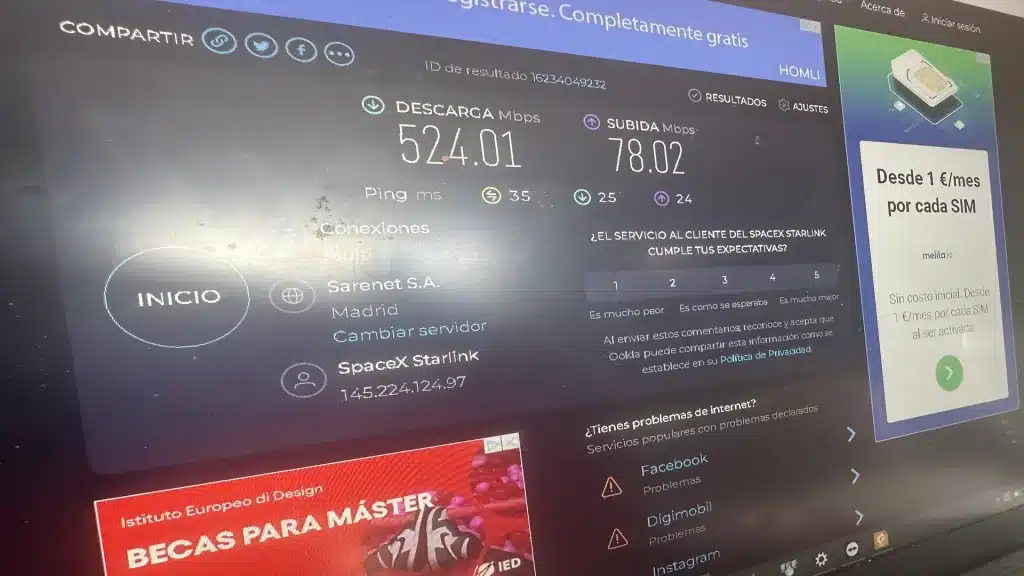
That low latency is key for live television. But a single Starlink terminal offers about 200 Mbps download and only 20 Mbps upload. For browsing or making video calls, that's more than enough. For sending a broadcast video signal to a TV network, it falls far short.
This is where the project's logic comes in: If one terminal isn't enough, you use several. And if a television broadcast requires a stable, high-capacity link, «several» means twenty.
Add twenty connections in one: the real challenge
Installing twenty Starlink antennas is the easy part. The hard part comes afterward. Each terminal has its own public IP, its own throughput, and its own latency variations. Turning all of that into a single link that behaves like fiber optic is a top-tier network engineering problem.
Plugging twenty routers into a switch isn't enough. The TCP/IP protocol doesn't work that way. A video stream is a conversation between two points that follows a specific route. If you split its packets across twenty different paths with different latencies, they arrive out of order. And out-of-order video is broken video.
Advanced bonding and routing
SD-WAN technology and link bonding were used to resolve this issue. Instead of distributing traffic rigidly, a network intelligence layer was deployed. This layer evaluates each link in real-time: its latency, jitter, packet loss, and free bandwidth.
With that information, the system distributes traffic packet by packet. It sends more data over the links that are performing best at any given moment. If one link's performance drops, it redistributes the load instantly.
Making this work with live video forced us to solve three challenges at once.
First, packet reordering. When traveling along twenty different paths, data arrives out of order. The bonding system reassembles them before delivering them, invisibly and with minimal delay.
Second, instant failover. If a terminal experiences a micro-outage—something common when the satellite switches links—its traffic is passed to the others in milliseconds. With no visible interruption in the signal.
Third, upload bandwidth management. Starlink offers much more download than upload. But television broadcasting depends precisely on the upload. All configuration prioritized this scarce resource to the maximum.
An unprecedented scale
The most advanced known Starlink bonding cases mention six or ten terminals. In Alaska, ten bonded antennas reached 1.2 Gbps for a rural community. In lab tests with six terminals, peaks of almost 2 Gbps have been achieved.
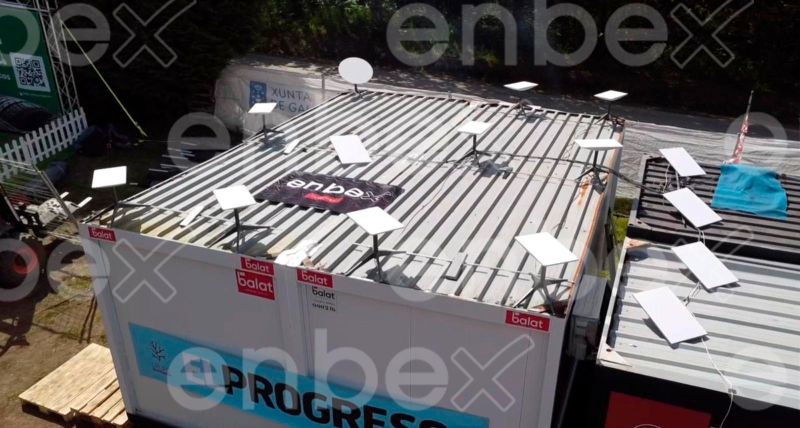
Enbex deployed twenty. Not in a lab, but on a motocross circuit. With a mobile TV unit depending on that link to broadcast a Grand Prix worldwide. As far as can be ascertained, no event of this nature has operated with this quantity of bonded terminals in live production.
Furthermore, each extra antenna adds complexity to the system. There are more latencies to compensate for. Satellite changes multiply. The routes to manage grow. The difficulty doesn't grow proportionally; it grows exponentially. That the system worked stably throughout the entire Grand Prix was the result of months of prior engineering and testing.
What traveled through that link: television for the world
The satellite farm was not an experiment. It was the main artery of the event. Its primary use was for television contribution: the video signal that left the mobile unit and traveled to the broadcast center.
The MXGP is the Motocross World Championship, organized by the FIM. Each Grand Prix is broadcast live globally through MXGP-TV and by the rightsholding broadcasters in each country. Millions of people watch this signal. If it is interrupted, the Grand Prix disappears from screens.
The video signal was encoded with the most efficient compression profiles on the market. It was transported using protocols designed for IP networks with latency variations. And it was continuously monitored throughout the entire broadcast: bit rate, total delay, packet loss, and audio-video synchronization.
Beyond Television: Connectivity for the Entire Event
Although television broadcasting was the top priority, the infrastructure also covered the event's other needs. The network was segmented so that production traffic always maintained absolute preference. Other services used the remaining capacity.
Press and Media
Accredited journalists and photographers needed to send reports, high-resolution photos, and video to their newsrooms. At a location without fiber or mobile coverage, the only option was Enbex's satellite network. A dedicated Wi-Fi network was created for the press, isolated from production traffic.
Organization and access control
Career direction, logistics, security, and public relations depended on the network. Accreditation systems validated each access in real-time against central servers. Timing and scoring systems also continuously transmitted data to the broadcast and track displays.
Service and hospitality areas
The VIP areas and sponsor spaces had their own WiFi coverage. Each zone had its own independent VLAN, sized for the anticipated number of users.
What you don't see: months of work before the weekend
This deployment was not improvised. The process began months earlier with a feasibility study. First, the sky view from each point on the circuit was studied. Potential obstacles for the antennas were also evaluated. Next, Starlink coverage in that geographical area was analyzed. Finally, the combined performance with different numbers of terminals was simulated.
Then came the tests. First with four terminals. Then with eight. Then with twelve. Each jump revealed new behaviors: interference between neighboring antennas, speed variations depending on the time of day, and limits of the routing equipment.
Once on the circuit, each terminal was positioned with just enough separation to prevent interference. Their orientation maximized the visibility of the orbital arc. And all were connected to the central routing system. Before the Grand Prix activity began, the entire link—all twenty bonded antennas sending a test signal—had already been validated.
Experience, judgment, and knowledge: the keys to the outcome
All the technology used in this project can be purchased on the market. Starlink terminals, SD-WAN equipment, professional encoders. Anyone can acquire twenty antennas. What can't be bought is knowing how to make them work together as broadcast infrastructure in a real live broadcast.
That ability is born from three things. The first is the experience of dozens of events where the network was critical and resources were limited. Each project teaches something about how networks behave under real pressure.
Secondly, the technical criteria. Knowing that twenty Starlinks can be bonded is theoretical. Understanding the optimal separation between antennas, the bonding adjustments to maximize uploads, or the necessary safety margin to absorb satellite fluctuations... that's only learned through practice.
And third, understanding the entire television production chain. Cameras, mixing consoles, encoders, transport protocols, broadcast centers. Designing a network that works for television requires knowing what each piece of that chain needs.
Result: The Grand Prix was broadcast without a single interruption
Throughout the weekend, the twenty-Starlink farm operated as planned. The TV signal reached the broadcast center without interruption. Accredited media sent their material without issues. The timing and access systems operated completely normally. And the organization had a stable network at all times.
All of this from a place without fiber optic. There was also no reliable mobile coverage. Nor any prior infrastructure. Twenty antennas looking up at the sky, a system that turned them into a single connection, and a team that knew exactly how to orchestrate it all.
If there is sky, there is connectivity. We may have broken a record by installing and bonding 20 Starlinks in the sky, aiming for the genius developed by a 21st-century genius, Elon Musk, and his company Starlink.
Deployment Specifications
Event: MXGP of Spain — FIM Motocross World Championship.
Connectivity 20 Starlink (LEO) terminals operating simultaneously, bonded via SD-WAN into a single logical link.
Priority use: Live television broadcast. Broadcast signal transport from the mobile unit to the transmission center for global distribution.
Additional services: Segmented WiFi for press, organization, accreditations, timing, and VIP areas.
Architecture VLANs with absolute priority for TV production. Automatic failover between terminals. Real-time monitoring of each link.
Scale: Largest known deployment of bonded Starlink terminals in a live broadcast production environment.
Result: Full Grand Prix broadcast without interruptions. Stable network for all services throughout the weekend.
Is your event being held at a location with no telecommunications infrastructure? Contact Enbex. If there is sky, there is connectivity.