
Audio and video over IP for events
Video, audio and sync travelling as data over two independent networks. If one fails, the live show carries on over the other.
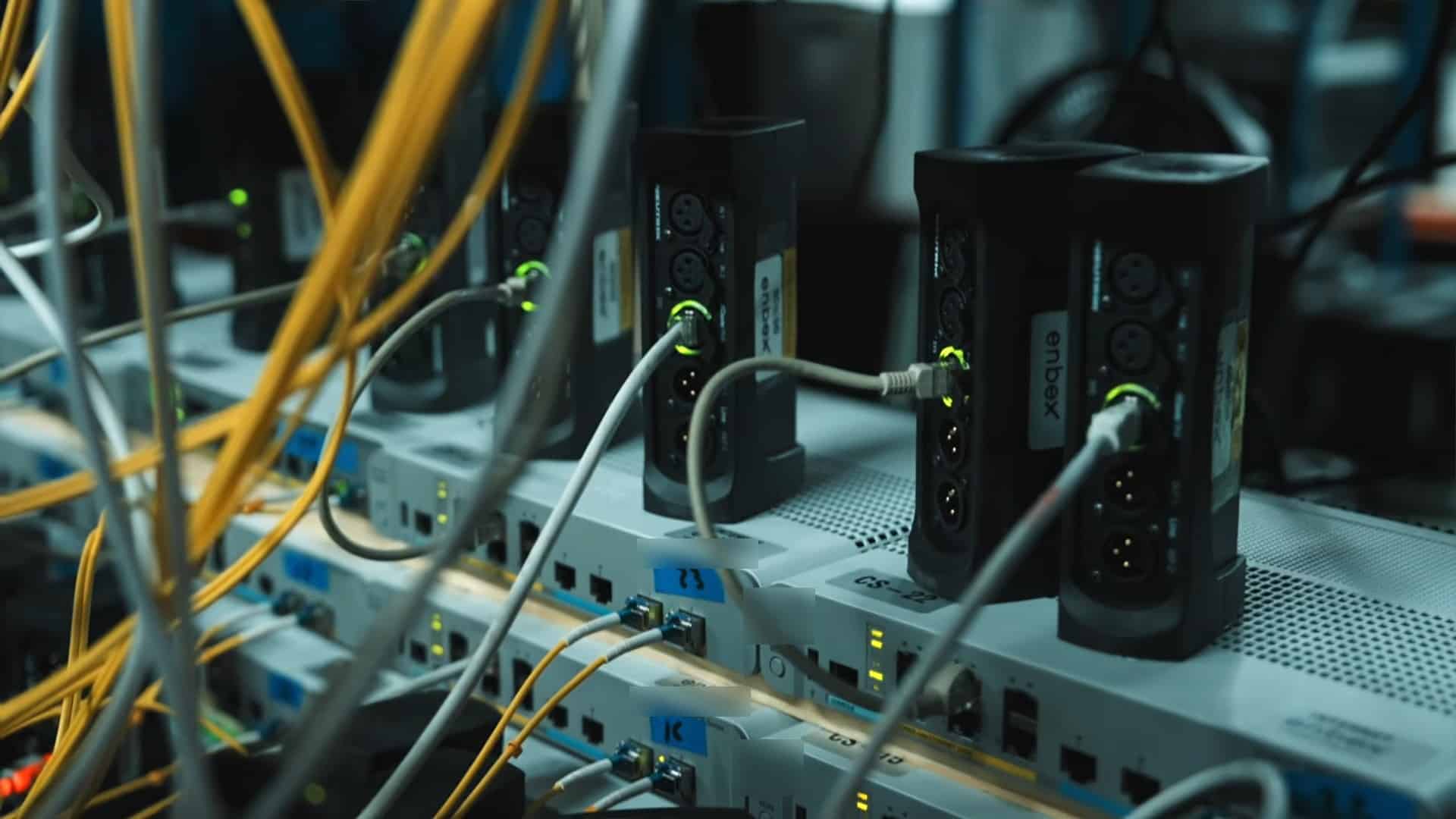
Audio and video over IP for events carries every signal of a live show as data over a network designed for broadcast, using the SMPTE ST 2110, AES67 and PTP standards. At enbex we design, build and operate that network: every critical signal travels over two independent networks, and a master clock with dual GNSS keeps picture and sound in phase across the whole venue. We have done it for more than a million people in Plaza de Cibeles and for a Champions League final.
The essentials
Six building blocks hold up a live audio and video over IP production. We build them and operate them as a single system.
SMPTE ST 2110
Video, audio and data travel as separate IP streams over the same network. Each stream reaches any point of the venue without running one cable per signal.
Two networks, A and B
Every critical signal leaves over two independent networks at the same time with SMPTE ST 2022-7. The receiver takes both and rebuilds the signal from the packets that arrive intact from either network.
Master clock with dual GNSS
A PTP (IEEE 1588) master clock with two GNSS modules and anti-jamming protection gives the time to the whole network. Audio and video have separate timing domains.
Networked audio
Dante, AES67 and ST 2110-30 coexist on the same network. Broadcast-grade digital consoles recall scenes and routing from the network.
Encoding with backup
H.264 and HEVC encoders and decoders carry the signal over the internet with encrypted SRT. Always with a backup encoder, as at the Champions League final.
NOC and telemetry
enbex NetBuilder documents, deploys and monitors the network. The NOC follows the network and the audio and video signals in real time.
Two networks, one live show
In a live audio and video over IP production, redundancy decides whether the audience notices a failure. This is how the enbex network behaves in four real situations.


Every camera, microphone, console and screen sends and receives over network A and network B at the same time. The master clock distributes the time over PTP to both networks, with boundary clocks that bring it closer to each device.


A switch fails or a fibre on network A is cut. The receiver was already getting the same packets over network B, so the signal carries on with no noticeable interruption: there is no switchover to wait for. The NOC sees the alarm straight away.


A nearby jammer blocks the satellite signal. The master clock has anti-jamming protection and a second, backup GNSS module, and the time keeps reaching the whole network over PTP.


The main encoder stops sending to the broadcaster or the platform. The backup was already standing by and takes over with no visible interruption, as at the Champions League final. The signal keeps going out over SRT.
What we bring to a live audio and video over IP production
Equipment is chosen for what it brings to each live show, not for the brand. We work with several manufacturers and integrate everything into the same network.
IP network
Data centre switches for uncompressed streams, fibre out to the furthest points, and every port labelled and documented.
Conversion and encoding
Converters between SDI, fibre and IP; H.264 and HEVC encoders and decoders with SRT.
Sync
PTP master clock with two GNSS modules and anti-jamming, boundary clocks and separate domains for audio and video.
Audio
Broadcast-grade digital consoles, Dante, AES67 and ST 2110-30, with scenes and routing orchestrated from the network.
Video
Vision mixers and control panels connected to the same network and the same time reference.
Power
One rack per service (video, audio, network and monitoring), with duplicated electronics and their own batteries.
Operations
A management network separate from the one that carries the show, and a real-time NOC with enbex NetBuilder.
Have a live show coming up?
Tell us what signals you have and we will propose the network.
Before the live show, the test bench
Before taking an audio and video over IP network to a venue, we build it on our test bench and validate sync, routing and redundancy. At the venue, every position is set up and tested before the live show starts.
That work is documented in enbex NetBuilder, enbex's own platform for designing, deploying and monitoring multi-vendor broadcast networks. The client does not depend on a technician remembering how everything is set up: the system documents it and reproduces it.

Video and audio telemetry, not just network telemetry
In audio and video over IP, a NOC that only checks whether the switches respond is too late. The enbex NOC adds telemetry from the video and audio signals to the network telemetry, to see a problem before it reaches the screen or the loudspeakers.
Target difference between devices set by the SMPTE ST 2059-2 profile.
GPS spoofing and jamming: why time cannot depend on a satellite
In an audio and video over IP network with ST 2110, every device orders packets by the same time, and that time comes from GNSS satellites. The signal reaches the ground very weak: a nearby jammer can block it (jamming) and a fake transmitter can give the clock the wrong time (spoofing). In a venue with thousands of phones, radio transmitters and security equipment, it is a real risk.
That is why the master clock we install has two GNSS modules, main and backup, and anti-jamming protection, and the time is distributed with boundary clocks and separate domains for audio and video. The target set by the SMPTE ST 2059-2 profile is a difference of 1 µs between devices.
Audio and video over IP in figures
Four figures from two live productions published in our case studies.
Live audio and video over IP productions we have delivered
Papal Visit to Madrid, 2026
On 7 June 2026, more than a million people followed Pope Leo XIV's mass in Plaza de Cibeles and the surrounding streets. enbex carried the video and audio over a single IP network with SMPTE ST 2110 to screens and sound located between 300 m and 2 km away. The details are in the IP broadcast case study at the Papal Visit.
2022 Champions League final
On 28 May 2022, at the Stade de France, enbex operated the mobile unit for TNT, Brazil and Mexico, with ten cameras and redundancy in the encoding and the network. The signal went out over encrypted SRT, with a backup encoder, to more than 35 million viewers. The details are in the 2022 Champions League final case study.

How we work
We visit the venue and list every signal: sources, destinations, distances and what goes out over the internet.
We design networks A and B, the sync and the contingency plan in enbex NetBuilder.
We build the network on the test bench and validate sync, routing and redundancy.
We deploy the per-service racks, the fibre and the management network at the venue.
We operate the live show with the NOC monitoring the network in real time.
We dismantle and leave the network documented in enbex NetBuilder.
It is the same engineering behind our audiovisual services for events, our streaming for events and our internet and WiFi for events.
Frequently asked questions about audio and video over IP
What is SMPTE ST 2110?
SMPTE ST 2110 is the family of standards that carries the video, audio and data of a live show as separate IP streams. Part 20 carries uncompressed video, part 30 carries audio, based on AES67, and part 40 carries ancillary data. All streams share PTP time according to SMPTE ST 2059, so a device can combine picture and sound that arrive over different paths.
Can Dante and ST 2110 coexist on the same network?
Yes. ST 2110-30 is based on AES67, and Dante devices can send and receive AES67 and ST 2110-30 streams. In practice, the event's Dante consoles and devices are integrated into the same network as the broadcast video, with their own PTP timing domain. We check it on the test bench before the live show, because each manufacturer implements it with its own limits.
What happens if the GPS signal is lost during a live show?
The network does not lose its time. The master clock has two GNSS modules, main and backup, and anti-jamming protection; if the satellite signal is lost, it keeps providing the time from its own oscillator for a limited period (holdover). Meanwhile, the NOC sees the alarm and the live show stays in sync.
What is SMPTE ST 2022-7 redundancy?
It is the standard for sending two identical copies of each stream over two different networks. The receiver rebuilds a single signal by choosing, packet by packet, the one that arrives intact from either network. If one network fails, the signal carries on over the other with no noticeable interruption and without waiting for any switchover. That is how we work at enbex: every sender transmits over network A and network B at the same time, and the decoders, consoles and converters receive from both.
Can you deliver the signal to a broadcaster or a platform over the internet?
Yes. We encode the programme feed in H.264 or HEVC and send it over encrypted SRT, with a backup encoder. That is how we delivered the 2022 Champions League final to TNT and to broadcasters in Brazil and Mexico.
Do you work with a particular equipment brand?
No. We choose each piece of equipment for what it brings to the live show and work with several manufacturers of networking, sync, encoding and audio. What has to be the same across all of them is the standard: ST 2110, AES67, PTP and SRT, tested together on our test bench.
Tell us what signals you have, how far they travel and where they need to go out. We will propose the audio and video over IP network, the sync and the contingency plan. Write to us via Contact us.