
Desde 2018, Enbex es el partner tecnológico de referencia para los principales eventos de ciberseguridad organizados por el Instituto Nacional de Ciberseguridad de España (INCIBE): el Encuentro Internacional de Seguridad de la Información (ENISE), CyberCamp y el Día de Internet Segura (SID)
Throughout eight consecutive editions, we have designed, deployed, and operated all of the telecommunications and audiovisual production infrastructure for these events, which have become the largest Spanish-speaking cybersecurity gatherings globally.
This article details the technical and operational scope of this ongoing collaboration, the quality standards under which we work, and the reasons why an event of the highest institutional demand entrusts the same company year after year to support its communications and audiovisual production.
INCIBE and its events: the context of maximum demand
INCIBE, based in León, is Spain's leading public entity for the development of cybersecurity and digital trust. It reports to the Ministry for Digital Transformation and Public Service and is responsible, among other functions, for responding to cybersecurity incidents, supporting industry, and raising citizen awareness.
Its main events represent the most visible institutional showcase of Spanish cybersecurity to the international community. ENISE, held every October at the León Congress and Exhibition Center, has drawn over 4,000 in-person attendees and more than 2,000 streaming connections, with 168 exhibiting companies and institutions and the participation of delegations from over 20 countries. CyberCamp, in its various itinerant editions, has brought together thousands of professionals, families, and young people for workshops, hacking competitions, and awareness-raising activities. Safer Internet Day (SID), with over 84,000 participants in some editions between in-person attendees and school connections, is one of Europe's largest digital awareness initiatives.
The technical infrastructure supporting these events must meet a requirement that goes beyond performance: it must be consistent with the message that INCIBE conveys. An organization whose mission is to guarantee the country's cybersecurity cannot afford connectivity failures, network vulnerabilities, or transmission interruptions. The technical infrastructure doesn't just have to work; it has to be exemplary.
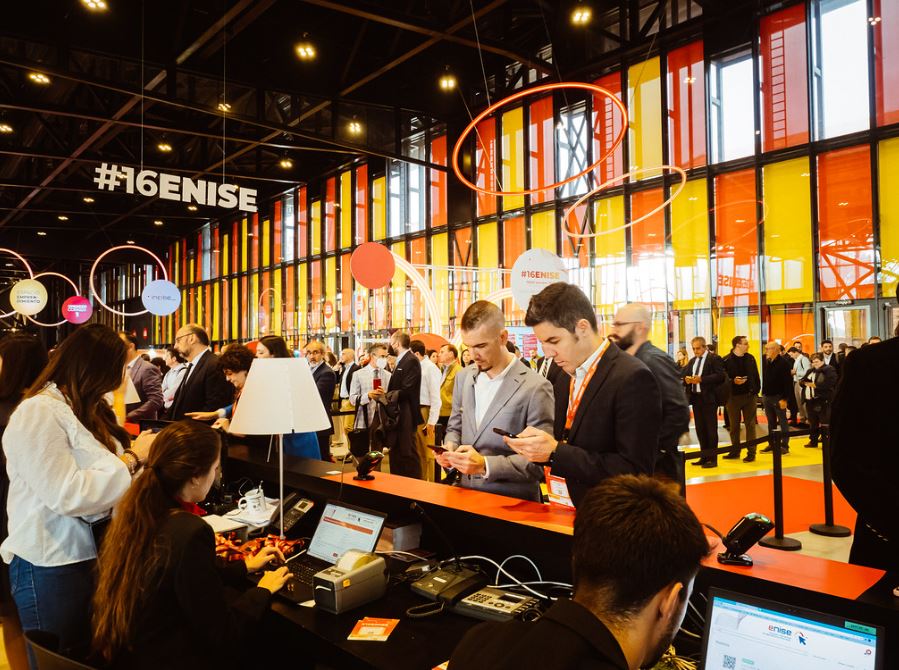
Telecommunications: Connectivity Under Contingency Standards
The telecommunications infrastructure deployed for INCIBE events is designed and operated under strict contingency standards. Each system component—from WiFi access points to backbone links—is dimensioned with complete redundancy and undergoes pre-event validation protocols.
WiFi for all event activities
WiFi coverage extends to the entire venue: main auditoriums, lecture halls, workshop areas, hackathon zones, exhibition area, networking spaces, and press areas. Each zone has distinct capacity and performance requirements that are addressed individually.
In the main plenaries, where hundreds of attendees are concentrated in a small space while following presentations, consulting online documentation, and sharing content on social media, device density per square meter reaches levels that require specific RF planning. In the hackathon zones, where participants run analysis tools, download packages, and work against remote servers, the demands on latency and bandwidth are significantly higher than in a conventional networking zone.
Network segmentation is performed using dedicated VLANs for each service type: audiovisual production, exhibition area, workshops, press, internal organization, and guests. Each segment operates with its own quality of service policies, its own bandwidth sizing, and its own perimeter security rules.
The relevance of this segmentation is especially significant at a cybersecurity event. Among the attendees are researchers, vulnerability analysts, and professionals whose daily activity consists of evaluating the security of networks and systems. The network infrastructure is configured with appropriate protection measures to operate in an environment where the technical level of the audience is, by definition, the most demanding that exists.
Wired connectivity for exhibitors and critical services
The more than 160 stands in the exhibition area, as well as the production, press, and organization areas, are equipped with dedicated Ethernet connections. Each connection is individually provisioned with the bandwidth, VLAN, and security policies corresponding to its function.
The ENISE exhibition area includes top-tier cybersecurity companies that perform live demonstrations of their products and solutions. These demonstrations frequently require high-performance internet access with low latency, and in some cases, specific network configurations that are coordinated in advance with each exhibitor.
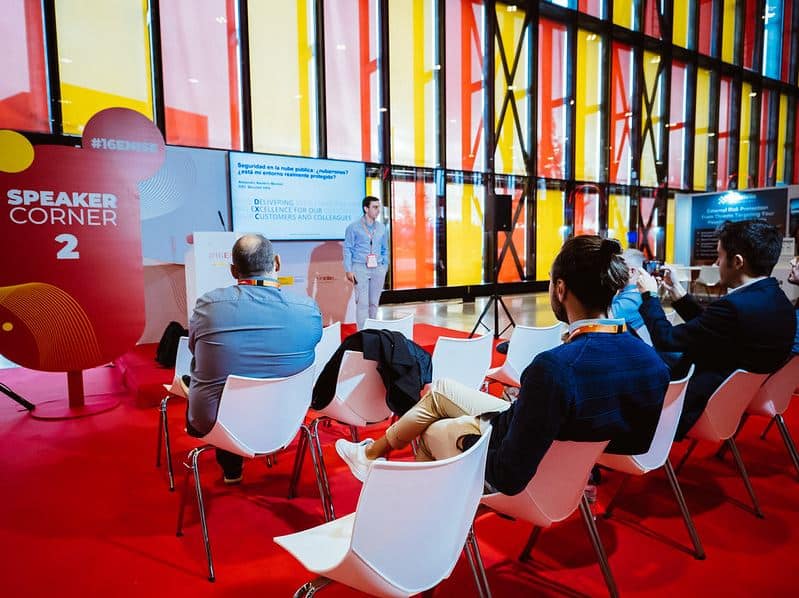
Redundancy and contingency: the standard INCIBE requires
The entirety of the telecommunications infrastructure is deployed under a high-availability model. Internet access links are multiple and from independent operators, managed through load balancing systems with automatic failover. Core switches operate in a redundant configuration. Trunk links have alternative paths. Critical service servers—DHCP, DNS, monitoring—are replicated to guarantee service continuity in the event of any component failure.
Contingency plans are formally documented and validated through pre-event testing. Failure scenarios are simulated—internet link failure, distribution switch failure, fiber segment degradation—and it is verified that failover mechanisms respond within the defined timeframes.
This level of requirement for contingency plans is not Enbex's voluntary decision; it is a contractual requirement from the client. INCIBE, as the body responsible for national cybersecurity, establishes technical standards for its events that directly reflect the principles it promotes. The telecommunications infrastructure must be an example of industry best practices, not only in performance but also in resilience, security, and documentation.
Audiovisual production: 4K multi-camera directing
In addition to telecommunications infrastructure, Enbex assumes full responsibility for the audiovisual production of events. This scope includes multi-camera production of sessions in various auditoriums and plenary halls, signal encoding for live streaming, recording of all sessions, and technical management of image and sound systems.
Simultaneous performance in multiple rooms
An event like ENISE doesn.
The production is carried out under 4K (Ultra High Definition) standards, which implies a resolution four times higher than conventional HD. This technical decision responds to a dual objective: to guarantee the maximum image quality for both live broadcasting and the generation of archival audiovisual content that INCIBE subsequently uses in its institutional communication channels.
Working in 4K represents a significant leap in the demands placed on the entire technical chain. Cameras, switchers, encoders, and transport links must operate at much higher data rates than standard HD. The bandwidth required to transport an uncompressed 4K signal is around 12 Gbps, which necessitates network infrastructure specifically sized for this traffic. Even with HEVC compression, 4K video streams remain considerably heavier than HD ones, which has direct implications for the sizing of transport links and storage capacity for recording.
Live streaming for a remote audience
All main sessions are broadcast live via the INCIBE website and its official channels. Remote audiences, which in some editions have exceeded 2,000 simultaneous connections, receive the signal with professional quality, with adaptive quality profiles that allow each viewer to receive the best possible resolution depending on their connection.
Streaming encoding is performed with professional equipment that guarantees low latency and high signal stability. The encoders generate multiple quality profiles simultaneously, so that the distribution platform can serve viewers with high-performance connections (who receive the signal in the highest resolution) and viewers with more limited connections (who receive optimized versions), without either of them experiencing interruptions or buffering.
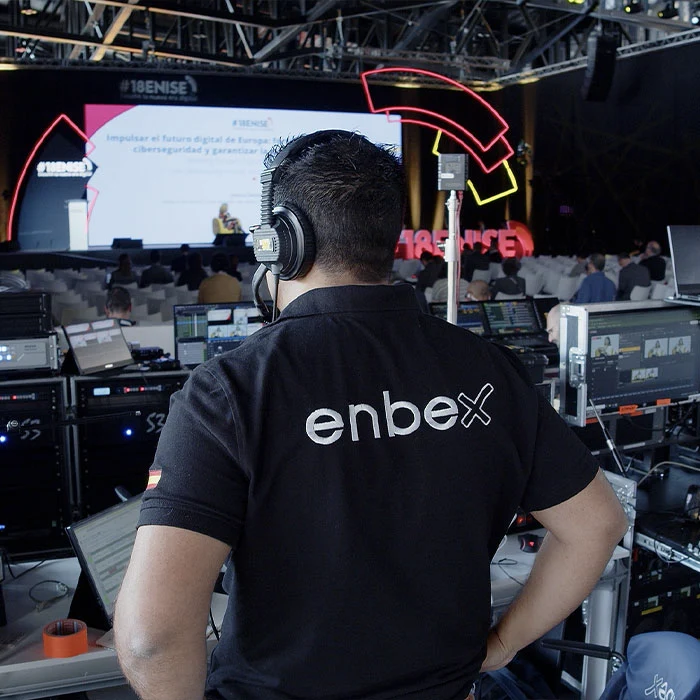
streaming for INCIBE event 4K production
Recording and archiving of content
All sessions—plenary sessions, roundtables, workshops, and special activities—are recorded in 4K quality for archiving and later publication. INCIBE publishes this material on its institutional channels and uses it as educational and outreach resources throughout the year. Therefore, the quality of the recorded material must be impeccable: correctly exposed, with professional audio, and with the basic editing necessary for direct publication.
Certifications and Management Systems: Documentary Support
Enbex's continued role as INCIBE's technical partner for eight consecutive editions is not solely based on technical capability. It is also supported by a certified management system that guarantees the quality, security, and sustainability of the services provided.
Enbex operates under an integrated management system that includes the following certifications:
ISO 9001 — Quality Management Systems. This certification attests that all organizational processes—from the design and planning phase to the execution and closure of each project—are carried out under documented procedures, with complete traceability, and with continuous improvement mechanisms. In practice, this means that each deployment follows a standardized verification protocol, each incident is recorded and analyzed, and the lessons learned from each iteration feed into process improvement for the next.
ISO/IEC 27001 — Information Security Management System. This certification is particularly relevant in the context of INCIBE's events. It certifies that Enbex manages information—both its own and that of its clients—under a risk control framework that includes access policies, information classification, security incident management, and regulatory compliance. For an organization like INCIBE, whose very purpose is cybersecurity, working with an ISO 27001 certified provider isn't an added bonus; it's a requirement of consistency.
ISO 14001 — Environmental Management Systems. This certification attests to the organization's commitment to minimizing the environmental impact of its operations. In the context of large-scale events, this translates into practices such as responsible e-waste management, optimizing energy consumption of deployed equipment, and logistics planning aimed at reducing the carbon footprint.
These certifications are not merely for show. They are periodically audited by independent certification bodies and represent a genuine commitment to management standards that go beyond mere technical capability. In public procurement processes—which is the standard method for awarding contracts for events organized by a public body such as INCIBE—these certifications serve as an objective evaluation criterion that distinguishes suppliers operating under accredited management systems from those that do not.
In addition to these certifications, there are manufacturer-specific accreditations for the technologies used in deployments: network equipment, audiovisual production systems, and streaming platforms. These accreditations guarantee that the equipment is configured and operated according to the manufacturer's specifications, with access to direct technical support in case of an issue.
Eight editions: what continuity means
A frequently overlooked but particularly significant piece of data is the continuity of this collaboration. From 2018 to 2025, Enbex has been consecutively selected for INCIBE events. In the realm of public procurement, where each edition involves a new technical and economic evaluation process, maintaining the award for eight consecutive years is an objective indicator of performance.
Each edition has presented its own challenges. The format of the events has evolved: more in-person attendees, a greater number of exhibitors, the incorporation of new activities such as hackathons and cybersecurity competitions, expansion of streaming to more rooms, and the transition to 4K standards in audiovisual production. Each of these changes has required adaptations in infrastructure design, resource sizing, and operational processes.
Continuity allows something that a change of provider cannot offer: accumulated knowledge. After eight editions, the specificities of the León Convention Center are known with a level of detail that no previous study can match. We know where RF interference appears, which areas concentrate more traffic at each point in the program, how the network load behaves when a plenary session ends and hundreds of people simultaneously move to the networking area, and which specific configurations work best for each type of activity.
This accumulated knowledge translates directly into reliability. Each new edition starts from a stronger foundation than the previous one, with more refined processes, tighter assembly times, and a capacity for anticipation that only repeated experience can provide.
Assistant profile: professionals who evaluate infrastructure
There is a differentiating factor that makes INCIBE events a particularly demanding technical challenge: the professional profile of the attendees.

ENISE brings together cybersecurity leaders from major corporations, researchers, threat analysts, specialized consultants, and representatives from government agencies from over 20 countries. These are professionals whose daily work involves assessing the security of technological infrastructures. A cybersecurity event that presented vulnerabilities on its own network or deficiencies in its communication systems would be a contradiction the professional community would not overlook.
This circumstance raises the level of demand on network infrastructure to a plane that transcends functionality. It's not enough for the network to work. It must work securely, with configuration that reflects industry best practices, with monitoring that allows any anomaly to be detected, and with an incident response capability that is consistent with the operating environment.
Result: The invisible infrastructure of Spanish cybersecurity
Throughout eight years of collaboration, INCIBE has been provided with a technical infrastructure that has uninterruptedly supported the country's largest cybersecurity events. Thousands of attendees have used the deployed networks to work, connect, and learn. Hundreds of presentations have been broadcast live with professional quality to audiences worldwide. Dozens of hackathons and workshops have been developed on network infrastructure designed to support the most demanding workloads. All of this has been done under the quality, security, and contingency standards that an organization like INCIBE requires.
For Enbex, this continued collaboration with INCIBE represents more than a recurring project. It represents the validation, edition after edition, of a technical and operational capability that is measured against the sector's most demanding standards. When the organization responsible for a country's cybersecurity trusts the same company for eight consecutive years to support its benchmark events, that fact speaks for itself.
Technical specifications
Customer: INCIBE – National Cybersecurity Institute of Spain.
Events: ENISE (National Cybersecurity Conference), CyberCamp, and Safer Internet Day (SID).
Period 2018 – 2025 (eight consecutive editions).
Headquarters León Congress and Exhibition Centre.
Telecommunications Complete WiFi and wired infrastructure for the entire premises, with VLAN segmentation, QoS policies, core and link redundancy, and documented and validated contingency plans.
Audiovisual production Simultaneous multi-camera production in multiple plenary rooms, to 4K standards. Encoding and streaming. Complete recording of all sessions for institutional archive.
Certifications ISO 9001 (Quality), ISO/IEC 27001 (Information Security), ISO 14001 (Environmental Management). Manufacturer accreditations in network technologies and audiovisual production.
Result: Eight consecutive editions without interruptions, with continuous evolution of technical standards in each new edition.
Does your organization need a technology partner with proven experience in high-demand institutional events? Contact Enbex.