
A WiFi network for sporting events is a temporary infrastructure that is designed, installed and operated for a venue that, a few days later, no longer exists. It has to serve bars, entrances, production and staff spread over kilometers, and do so without a single outage during the race weekend.
For the Spanish Formula 1 Grand Prix, held on September 11–13, 2026 at the MADRING circuit at IFEMA Madrid, enbex designed and operated the network that connected the venue. Close to 300 access points, more than 60 switches, more than 8 kilometers of optical fiber and 9 kilometers of data cable, installed in 15 days. This article explains how a network like this is built, which services depend on it and what we learned along the way.
The challenge: connecting a street circuit that is built in two weeks
MADRING is a 5.4-kilometer layout on the roads of IFEMA Madrid and a short stretch of public road. Unlike a permanent circuit, almost all of the service infrastructure is installed for the event and removed afterwards. As a result, the network cannot rely on existing ducts or cabinets: fiber has to be laid, electronics installed at temporary locations and protected from rain, dust and vehicle traffic.
Then there is the scale. Public, hospitality and service areas are spread across the whole venue, with distances far beyond the reach of copper cable. Optical fiber is therefore not an option but the foundation of the design.
Which services depend on the network during the Grand Prix
At an event of this size, the network is not just WiFi for the public. In fact, the most critical services lie elsewhere, and each one has a different cost if it fails.
| Service | What happens if it fails? | |
| Payment terminals (POS) at bars and shops | Sales stop: queues and direct loss of revenue | Network segmented by zone, overlapping APs and traffic priority |
| Access control and accreditation | Queues at the entrances and a security risk | Dedicated network profile, isolated from the rest |
| Staff and production communications | Loss of coordination in the operation | Dedicated profile with coverage in work areas |
| Management and monitoring | Loss of visibility over the network | Separate management network and out-of-band access over 4G |
15 days of installation, in phases and with a test bench beforehand
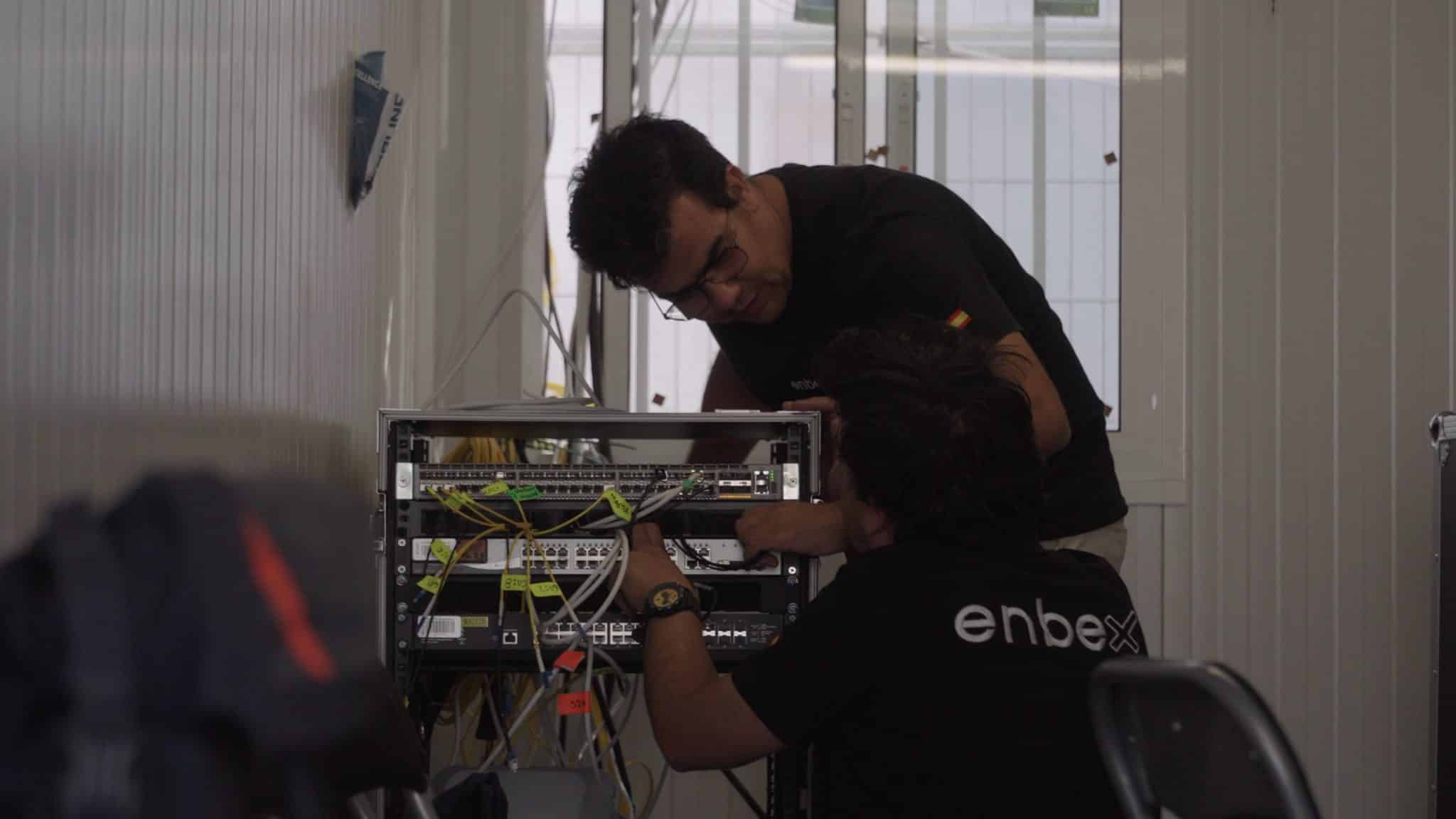
The installation was planned alongside the construction of the venue itself. First, the backbone fiber was laid and the network core was put in place. Next, the distribution electronics were installed zone by zone and, finally, the access points, as the final structures became available. This sequence makes it possible to validate each section before relying on it.
Before deployment, the full configuration was tested on a test bench at enbex's facilities. The equipment arrived at the circuit with its configuration loaded and verified, and time on site went into installing and checking, not configuring.

The architecture of the MADRING sporting event WiFi network
The network was organized in three tiers: a central core, distribution per zone and access. That hierarchy, common in corporate networks, is rare in temporary deployments. However, it is what keeps a failure in one zone from affecting the rest of the venue and lets any change be applied in an orderly way.
| Tier | Equipment | Role |
| Core | Arista switch with 10 Gb/s links | Meeting point for all zones, internet egress and central services |
| Distribution | Arista switches per zone, 10 Gb/s fiber uplink | Aggregate the access layer of each zone and isolate local failures |
| Access | Multi-vendor PoE switches (more than 60 in total) | Power and connect the access points and the services in each tent or bar |
| Wireless | Close to 300 RUCKUS Wi-Fi 7 APs, indoor and outdoor, redundant controller | Service for POS, entrances, production and staff |
| Management | Separate network + 4G out-of-band access | Operate the network even if the service network has a problem |
More than 8 kilometers of fiber and an Arista core
The core and the main distribution points were built on Arista switches, chosen for their 10 Gb/s per-link capacity and the stability of their operating system in demanding deployments. From each distribution point, PoE access switches deliver service and power to the access points. Every critical fiber link was designed with a pre-configured spare port, so an optic failure is solved by moving a patch cord, without reconfiguring anything
A Layer 2 that does not go down because of a miswired cable
In a deployment with dozens of switches and kilometers of cable, the most common risk is not a device that breaks, but a cable plugged in where it should not be. An accidental loop can take down an entire network in seconds. That is why every switch was configured with loop protection, storm control and automatic blocking of the port that causes the problem. In other words, the error is contained where it happens and does not spread.
This approach is part of the network doctrine enbex applies to all its multi-vendor deployments with Arista, Cisco and RUCKUS. It is the same one behind the broadcast network for a major live production or the WiFi and internet network for an event.
Are you planning a high-density sporting event and cannot afford connection failures?
Live operation: NOC, telemetry and AI agents
During the three days of the Grand Prix, enbex operated the network from a NOC set up at the venue itself. Every link, every switch and every access point sent telemetry to an advanced monitoring platform. Real-time dashboards showed port status, link utilization, clients per AP and radio errors. AI agents developed by enbex work on that data: they correlate signals from different sources and alert the technician to a degradation before it turns into an outage. The client also had its own portal with an AI assistant to check the status of the network in natural language.
| Indicator | Value | Source |
| Access points installed | Close to 300 | enbex inventory |
| Switches | More than 60 | enbex inventory |
| Optical fiber laid | More than 8 km | enbex inventory |
| Data cable | 9 km | enbex inventory |
| Installation time | 15 days | enbex planning |
| Public areas connected | 5 fan zones | enbex design |
| POS terminals, card readers and tablets connected | More than 3,000 | enbex operations |
| Event dates | September 11–13, 2026 | Official FIA / MADRING calendar |
Traceability: every change with a rollback point
The entire configuration was documented device by device before the event, with a reference copy stored on each switch. Any change during the weekend was applied with an automatic rollback timer: if the change cut off access, the device reverted to the previous configuration on its own. As a result, nobody had to go to a cabinet to recover a device.
What we learned
- Testing on a bench before deploying saves days on site and prevents errors in the field.
- Electronics reused from other deployments are wiped and rebuilt; they are never adapted.
- Optics are ordered in pairs and with spares: the faulty one always turns up.
- Out-of-band access is not optional at a 5-kilometer venue.
Project Specifications
| Concept | Specification |
| Event | Spanish Formula 1 Grand Prix, September 11–13, 2026 |
| Venue | MADRING circuit, IFEMA Madrid (5.4 km) |
| Access points | Close to 300 RUCKUS, indoor and outdoor |
| Switching | More than 60 switches; Arista core and distribution |
| Cabling | More than 8 km of optical fiber; 9 km of data cable |
| WiFi controller | Redundant (high availability) |
| Network profiles | Payments, access control, production, staff, management |
| Layer 2 protection | Loop control, storm control and port blocking |
| Management | Separate network; out-of-band access over 4G |
| Monitoring | Real-time telemetry, dashboards, in-house AI agents and client portal |
| Installation time | 15 days |
| enbex certifications | ISO 9001, ISO 27001, ISO 14001, ENS · RUCKUS Elite Partner · CCNP Enterprise and CWNA certified team |
We build and operate the network for your sporting event, on fixed deadlines and without outages. Contact enbex.
Frequently asked questions about WiFi networks for sporting events
What is a WiFi network for sporting events?
It is a temporary wired and wireless network, installed for a sports venue, that connects payments, access control, production and staff during the competition days. It is designed not to go down and is removed when the event is over.
How long does it take to install the network for a major sporting event?
It depends on the venue. At the Madrid Formula 1 Grand Prix, enbex installed close to 300 access points, more than 60 switches and 8 kilometers of fiber in 15 days. The configuration was tested on a bench beforehand.
Why is optical fiber used at a circuit?
Because the distances between zones exceed the 100 meters that copper cable supports, and because fiber is immune to electrical interference from generators and screens.
Is the event WiFi for the public?
Not necessarily. At MADRING the network served the operation: payment terminals, access control, production and staff. WiFi for the general public is designed separately, with high-density criteria.
What happens if the network goes down mid-race?
The design contains the failure in the zone where it occurs, neighboring access points take over the coverage and the NOC detects it within seconds. No anticipated failure requires physical intervention to restore service.
Does enbex build networks for sporting events across Spain?
Yes. enbex designs and operates networks for sporting and motorsport events across Spain, based in Madrid and with its own team. See WiFi and internet for events in Madrid.

Enrique Romero
Co-founder of enbex and head of IP network architecture · “Since 2009 he has designed and operated networks for events, conferences and broadcast production. Certified in CCNP Enterprise, Cisco SD-WAN, CWNA and RUCKUS Network Implementer.”