
The evolution of WiFi runs from the 2 Mb/s of the first IEEE 802.11 standard, approved in 1997, to the several gigabits per second of Wi-Fi 7, which the Wi-Fi Alliance has certified since January 2024. Each generation has added bands, wider channels and denser modulation. The next one, Wi-Fi 8, changes its goal: it aims for a more reliable connection, not more speed.
Updated on 28 October 2026.
What is WiFi?
Wi-Fi is a trademark of the Wi-Fi Alliance, the organisation that certifies that equipment based on the IEEE 802.11 wireless local area network (WLAN) standards works together. It was founded in 1999 as the Wireless Ethernet Compatibility Alliance (WECA). The IEEE writes the standards; the Wi-Fi Alliance certifies the products and gives them a commercial name, such as Wi-Fi 6 or Wi-Fi 7.
Each generation responds to more traffic demand with limited spectrum. 802.11a, for example, took WiFi to the 5 GHz band to get away from interference in the 2.4 GHz band, the radio band of the original standard. Maximum theoretical speed has gone from 2 Mb/s in 1997 to 600 Mb/s with 802.11n and to several gigabits per second with Wi-Fi 6 and Wi-Fi 7.
You can also learn about the WiFi configuration, administration and monitoring with Nagios.
WiFi generations and standards: summary table
This table lists each general-use IEEE 802.11 standard, its commercial name, when the IEEE approved it, when the Wi-Fi Alliance began certifying equipment, which bands it uses and its maximum theoretical speed.
| Wi-Fi Alliance name | IEEE standard | IEEE approval | Wi-Fi Alliance certification | Bands | Maximum theoretical speed* |
|---|---|---|---|---|---|
| (no name) | 802.11 | June 1997 | — | 2.4 GHz | 2 Mb/s |
| (no name) | 802.11b | September 1999 | April 2000 | 2.4 GHz | 11 Mb/s |
| (no name) | 802.11a | September 1999 | January 2003 | 5 GHz | 54 Mb/s |
| (no name) | 802.11g | June 2003 | 2003 | 2.4 GHz | 54 Mb/s |
| Wi-Fi 4 | 802.11n | September 2009 | June 2007 (on draft 2.0) | 2.4 and 5 GHz | 600 Mb/s |
| Wi-Fi 5 | 802.11ac | December 2013 | June 2013 | 5 GHz | 6.9 Gb/s |
| Wi-Fi 6 | 802.11ax | February 2021 | September 2019 | 2.4 and 5 GHz | 9.6 Gb/s |
| Wi-Fi 6E | 802.11ax in 6 GHz | February 2021 | January 2021 | 2.4, 5 and 6 GHz | 9.6 Gb/s |
| Wi-Fi 7 | 802.11be | September 2024 | January 2024 | 2.4, 5 and 6 GHz | 23 Gb/s |
| Wi-Fi 8 | 802.11bn | Expected May 2028 | No date announced | 2.4, 5 and 6 GHz | No official figure |
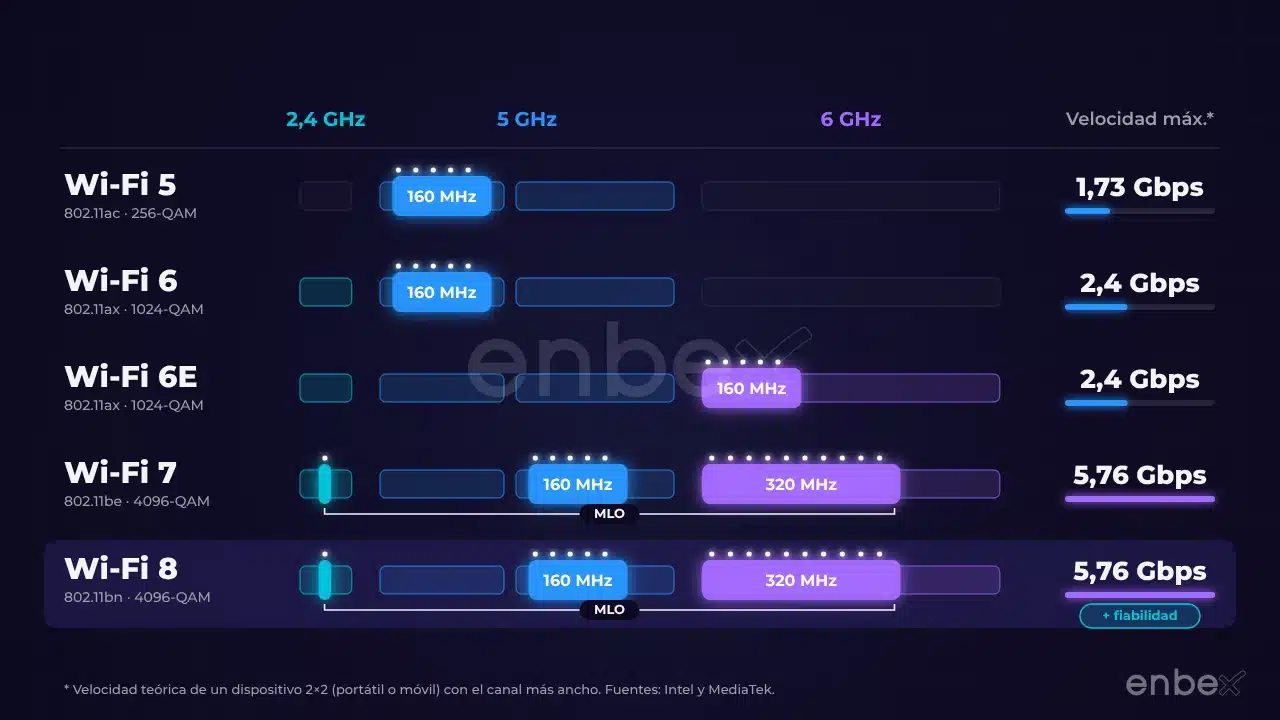
*Maximum PHY rate of the standard with all spatial streams and the widest channel: 4 streams in Wi-Fi 4 and 8 in Wi-Fi 5, 6 and 7. A phone or laptop with two antennas falls well short: about 2.4 Gb/s in Wi-Fi 6E and 5.76 Gb/s in Wi-Fi 7. The 46 Gb/s figure quoted for Wi-Fi 7 assumes 16 spatial streams. The Wi-Fi Alliance created the names Wi-Fi 4, 5 and 6 in October 2018; 802.11b, a and g have no official number. The 6 GHz band arrived with 802.11ax, and the Wi-Fi Alliance certifies it under the name Wi-Fi 6E. Sources: official IEEE 802.11 timeline, Wi-Fi Alliance announcement of Wi-Fi CERTIFIED 7 and Juniper Wi-Fi 7 documentation.
What each generation has brought
From 802.11b to 802.11g: 2.4 and 5 GHz
802.11b raised the speed to 11 Mb/s in 2.4 GHz and was the standard of the first certified equipment, in April 2000. 802.11a used the cleaner 5 GHz band, at 54 Mb/s. 802.11g brought those 54 Mb/s to 2.4 GHz while remaining compatible with 802.11b.
Wi-Fi 4 and Wi-Fi 5: multiple antennas and wide channels
Wi-Fi 4 (802.11n) introduced MIMO: up to four spatial streams over several antennas, 40 MHz channels and operation in 2.4 and 5 GHz, up to 600 Mb/s. Wi-Fi 5 (802.11ac) stayed in 5 GHz only and widened the channel to 80 and 160 MHz with 256-QAM modulation, up to about 6.9 Gb/s with eight streams. A wider channel gives more speed, but not more range.
Wi-Fi 6 and Wi-Fi 6E: efficiency with lots of people
Wi-Fi 6 (802.11ax) was designed for spaces with many devices. OFDMA shares one channel among several users at the same time, multi-user MIMO, already used by Wi-Fi 5, sends data to several devices in parallel, and 1024-QAM modulation packs more data into the same spectrum. Wi-Fi 6E is the same technology in the 6 GHz band, which the Wi-Fi Alliance has certified since January 2021.
Wi-Fi 7: 320 MHz channels and MLO
Wi-Fi 7 (802.11be) doubles the widest channel to 320 MHz, only in 6 GHz, and raises modulation to 4096-QAM, 20 % more transmission speed than 1024-QAM. Its main new feature is multi-link operation (MLO): a device uses links in several bands at once and spreads traffic between them.
In the European Union, the 6 GHz band for WiFi runs from 5,945 to 6,425 MHz. Only one 320 MHz channel fits without overlapping, so a network with many access points is designed with narrower channels. This is what we take into account in every business WiFi network installation.
Wi-Fi 8: reliability instead of speed
Wi-Fi 8 (802.11bn, Ultra High Reliability) does not aim for a higher maximum speed. Its targets are at least 25 % more useful data with the same signal, 25 % lower latency at the worst moments and 25 % fewer packets lost when moving from one access point to another. The IEEE expects to approve it in May 2028 and the Wi-Fi Alliance has not set a certification date. We explain in detail what Wi-Fi 8 is and when it is coming.
A separate branch: 802.11ad at 60 GHz
802.11ad, known as WiGig, uses the 60 GHz band for links of up to about 10 metres, in the same room or with line of sight. The IEEE approved it in October 2012 and the Wi-Fi Alliance began certifying it in October 2016, at up to 8 Gb/s. It is not part of the Wi-Fi 4–8 numbering.
If your office network is falling short, here is how to boost your WiFi speed with 5 more effective tricks. And if you are renewing it and are unsure between Wi-Fi 6E and Wi-Fi 7, the answer depends on the devices and user density: we look at it in the preliminary study of each project. To equip an event, see our professional WiFi equipment guide or tell us about your project.