
When Adidas organizes an event with Leo Messi, there's no room for improvisation. Every second of broadcast counts, every camera has to perform, and the internet connection absolutely cannot fail. Enbex was the technical partner responsible for designing, deploying, and operating all the connectivity and audiovisual production infrastructure for the event. In this article, we walk through, step by step, how we did it and why every technical decision was crucial for everything to go as planned.
The challenge: a live event with zero tolerance for failure
Working with a brand like Adidas in an event featuring Lionel Messi implies a level of demand that doesn't allow for half-measures. We are talking about a broadcast in which hundreds of viewers will be connected simultaneously expecting a stable, fluid, and professional-quality signal. If the image freezes for two seconds, if the audio cuts out, if the stream falls during the appearance of Messi...the reputational damage is enormous and there are no second chances.
The request we received was clear: ensure uninterrupted internet connectivity at the event location and Produce a live multi-camera broadcast with broadcast quality. Nothing more and nothing less.
Redundant Connectivity: Why a Single Line Is Never Enough
Any technician who has worked on live events knows that relying on a single internet connection is like playing Russian roulette. It doesn’t matter if the provider promises 99.91% uptime; that 0.11% always seems to show up at the worst possible moment. That’s why our first decision was to design a fully redundant connectivity architecture.
We deploy multiple internet access links from different operators and technologies. The idea is simple but critical: if one line goes down, the others transparently absorb the traffic, without the end viewer noticing anything at all. But it's not enough to just have several cables plugged in. You need the traffic to be distributed intelligently and for the system to react in milliseconds to any degradation.
Load balancing: the brain of connectivity
To manage these multiple links, we implemented an active load balancing system. This type of configuration does more than simply distribute packets across different lines. It monitors latency, packet loss, and available bandwidth on each link in real-time, and makes routing decisions on the fly.
In practice, this meant that throughout the event, we had a control panel where we could see the status of each connection in real time. If a line started showing signs of congestion or packet loss, the balancer would automatically redirect critical traffic—fundamentally, the video stream—to the more stable links. All of this happened without manual intervention and, most importantly, without visible interruptions to the broadcast.
It's not a trivial setup. It requires a thorough understanding of each operator's behavior in the area, correctly sizing the necessary bandwidth for the retransmission (which is considerable with multi-camera HD quality), and having failover protocols tested before D-Day. We performed stress tests days before the event, simulating failures of each link to verify that the system responded exactly as we expected.
Multicamera production: telling the story from every angle
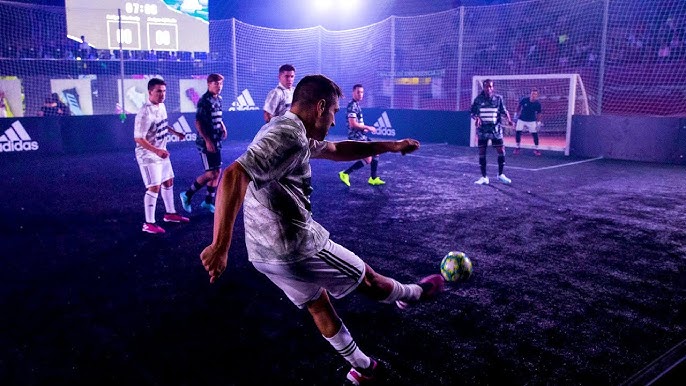
An event with the presence of Lionel Messi cannot be covered with a single static camera. The multi-camera production allows the director to choose at any time the shot that best tells what is happening: a wide shot of the stage, a close-up of Messi, the audience's reaction, a product detail... The visual richness of a multi-camera production Professionalism is what separates a run-of-the-mill corporate broadcast from a real television-quality broadcast.
For this event, we set up several cameras in strategic locations, each connected to the central production system. The director had access to all the feeds in real time and could switch between them cleanly and smoothly, just like during a sports broadcast or a live television program.
Haivision Makito Encoders: The Key Piece of Streaming
This is where one of the most critical components of the entire technical chain comes into play: encoders. An encoder is the device that takes the raw video signal coming out of the cameras and compresses it in real-time so it can be sent over the internet without saturating the available bandwidth. The quality of the encoder directly determines the quality of what the end viewer sees.
For this event, we worked with encoders. Haivision Makito, which are the absolute benchmark in the professional broadcast sector. Makito devices are used by major television networks, defense organizations, and large organizations worldwide precisely because they offer something very few devices can achieve: compressing HD video while maintaining exceptional image quality, with extremely low latency and bombproof reliability.
Makito encodes video in H.264 and HEVC (H.265), which allowed us to optimize bandwidth usage without sacrificing resolution or smoothness. With HEVC, bandwidth consumption can be reduced by up to 50% compared to H.264 while maintaining the same perceived quality—a critical factor when sending multiple video streams simultaneously over internet connections.
Additionally, the Makito incorporates native support for the protocol SRT (Secure Reliable Transport), developed by Haivision itself. SRT is a transport protocol specifically designed for sending live video over unmanaged networks like the internet. Its major advantage is that it compensates in real-time for typical IP network issues: packet loss, jitter, bandwidth fluctuations, and variable latency. In other words, even if the network has its bumps, SRT ensures that video arrives at its destination stably and with the lowest possible latency.
For an event of this magnitude, with the pressure of hundreds of simultaneous viewers and the image of Adidas and Messi on the line, working with encoders of this caliber wasn't a luxury; it was an absolute necessity.
The live broadcast: hundreds of simultaneous viewers
With the connectivity infrastructure secured and the multi-camera production underway, the signal left the Makito encoders and was distributed to the streaming platform where hundreds of viewers consumed it in real-time.
Managing hundreds of simultaneous viewers requires more than just a good encoder and a good connection. You need to correctly size the CDN (Content Delivery Network), ensure that the adaptive bitrate profiles are well configured so that each viewer receives the best possible quality according to their connection, and monitor real-time metrics such as buffering ratio, playback start time, and abandonment rate.
Throughout the broadcast, we maintained active monitoring of all these parameters. The result was a stable transmission from start to finish, with no interruptions, no perceptible drops in quality, and a viewing experience that lived up to what an Adidas event with Messi demands.
What you can't see but makes a difference
Behind every live broadcast that seems simple, there are tens of hours of planning, testing, and preparation. There's a pre-technical visit to the location to assess coverage, electrical infrastructure access, and camera installation points. There are meetings with event organizers to understand exactly what they want to broadcast and how. There's a documented Plan B (and Plan C) for every possible failure scenario.
In the case of this event, this preparation included everything from negotiating with multiple telecommunications operators to secure redundant links, to the comprehensive cabling of the venue, to the configuration and testing of each encoder, each camera, and each point in the signal chain.
There's also a human team in the shadows that often goes unnoticed. Network technicians monitoring connections, a director making creative decisions in real-time, professional camera operators, and a technical coordinator who bridges the gap between production needs and the reality of available infrastructure.
Result: Broadcast quality for a brand that accepts nothing less
At the end of the day, the success of a project like this is measured in a very simple way: did the viewer enjoy a clean, uninterrupted broadcast with professional quality? The answer was yes. Hundreds of viewers were able to follow the event with Messi live with a stable signal, dynamic multi-camera direction, and image and sound quality that was second to none compared to a conventional television production.
For enbex, These types of projects are what define us. It's not just about bringing equipment to a site and plugging it in. It's about understanding the context, sizing the right solution, anticipating problems, and executing with the precision that a client like Adidas demands. Technology is important—the Makitos, load balancing, link redundancy—but what really makes it work is the experience of knowing how to orchestrate all those elements under the pressure of a live event where there's no pause or do-overs.
Technical deployment summary
Connectivity Multiple internet links with diverse providers and technologies, managed through active load balancing with automatic failover and real-time monitoring of latency, packet loss, and bandwidth.
Audiovisual production Professional multi-camera production with multiple camera positions, a live production switch, and specialized technical equipment.
Encoding and streaming Haivision Makito encoders with H.264/HEVC encoding and SRT protocol for secure and reliable video transport over IP.
Audience Hundreds of simultaneous viewers with active quality of experience (QoE) monitoring.
Result: Full broadcast without interruptions, without quality degradation, and with broadcast production standards.
Does your company need a professional connectivity and relay solution for an event? Contact Enbex And tell us about your project.